A Guide To Australian Standards For School Athletics Track Equipment
Track equipment for schools might pass a quick visual check, but that does not always mean it is ready for student use. Even minor issues with condition, setup or suitability can quickly affect safety and performance.
In this guide, the team at Buffalo Sports breaks down the safety standards and guidance that may apply to athletics track equipment. We also look at how safe equipment selection applies across common track and field activities.
What safety standards apply to school athletics track equipment?
There is no single Australian Standard that covers every piece of school athletics track equipment. Instead, schools usually need to review a combination of Australian Standards, state or territory education guidance, athletics body specifications and supplier recommendations.
For school athletics, the most relevant guidance usually falls into three areas:
- Event rules and specifications — Bodies such as Australian Athletics, Little Athletics Australia, School Sport Australia and state school sport associations provide technical information for events such as hurdles, shot put, discus and high jump. These specifications can guide details like implement weights, hurdle heights, landing area requirements, event layouts and competition formats for different age groups.
- Surfacing and impact areas — Where athletic activities involve running, jumping, landing or shared play spaces, schools may need to consider standards around playground surfacing, impact attenuation and slip resistance. This is especially important for landing zones, run-up areas, synthetic surfaces and multi-use sports spaces.
- Equipment setup and risk control — Schools should also review how equipment is installed, anchored, stored and maintained. This applies to items such as high jump mats, throwing cages, hurdles, starting blocks and any equipment used near shared school activity areas.
Safety considerations for core athletics equipment
Once schools understand the broader standards and guidance, the next step is to review the equipment used across common athletics events. Each event creates different risks, so the equipment should match how students run, jump, land, throw or start.
High jump safety
For high jump, the landing area is the main equipment priority. Schools should check that the padding provides both impact absorption and resilience when compressed, especially if the mat is used regularly across PE lessons, training and carnivals.
Minimum padding requirements can vary depending on the age group and activity risk level. As a guide, Little Athletics Australia rules require under-17 medium-risk high jump activities to use padding at least 5m x 3m, with thickness generally between 15cm and 30cm depending on the activity. For higher-risk under-17 activities, padding should still be at least 5m x 3m, with a minimum thickness of 40cm, while 50cm is recommended.
For students aged 17 and over, higher padding levels may apply. Medium-risk activities may require a 5m x 3m landing area with at least 50cm thickness, while high-risk activities under World Athletics guidance may require padding not less than 5m long x 3m wide x 0.7m high.
If spikes are worn, the landing area should include a single spike-proof top mat of around 5cm thickness, ideally with a weatherproof cover for outdoor or regular school use. Spike length should also be checked, with Little Athletics Australia guidance allowing up to 9mm on synthetic surfaces and 12mm on grass surfaces.
Shot put and discus
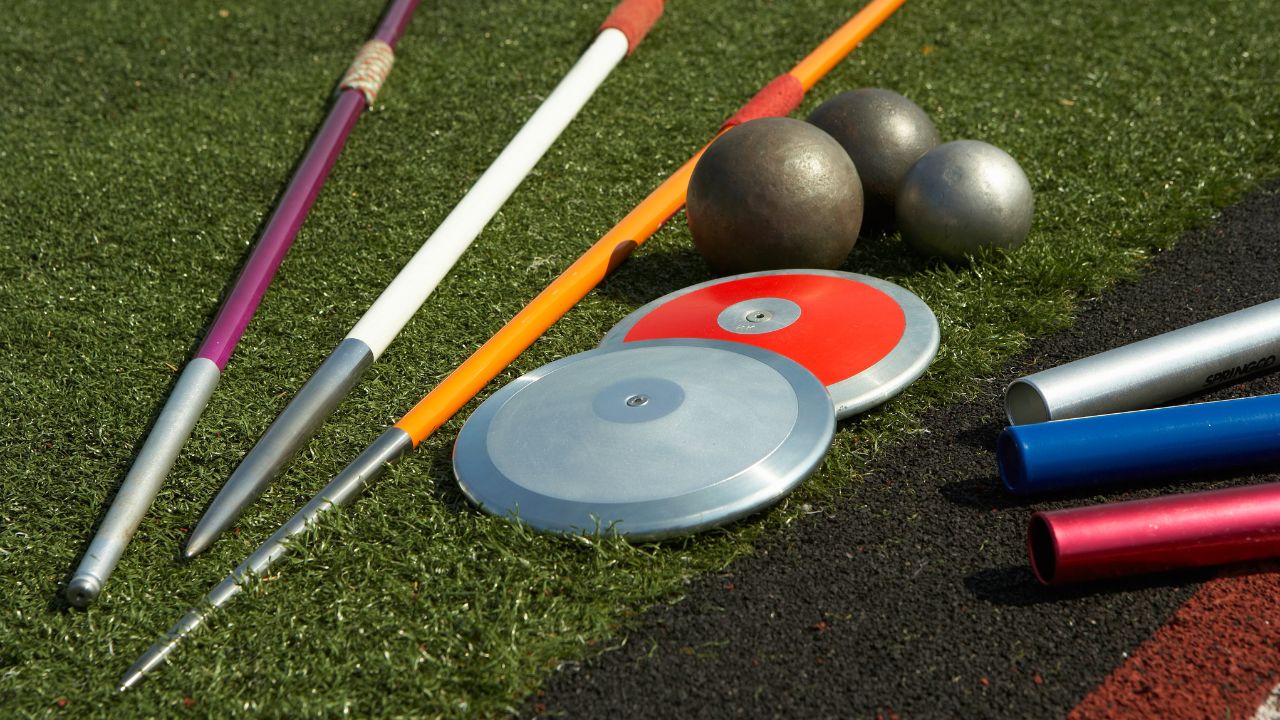
Shot put and discus areas need clear controls because both events involve heavy implements travelling at speed. Throwing circles should be stable, clearly marked and suitable for the surface being used.
For discus, a safety cage or throwing cage is an important part of a controlled setup. It helps reduce the risk of stray implements leaving the intended throwing area. Schools should check that cages, netting and support frames are secure, correctly positioned and suitable for the level of use.
Hurdles and starting blocks
Hurdles and starting blocks need to support speed, movement and repeated use without creating unnecessary trip or slip risks. Hurdles should be easy to adjust, stable when positioned and suitable for the age group using them. Damaged edges, loose parts or uneven height settings should be checked before use.
Starting blocks should provide a firm, non-slip surface for sprint starts. Schools should review the block frame, foot plates and grip to make sure students can push off safely without the equipment shifting.
How to check if your current equipment still meets 2026 safety benchmarks
A 2026 equipment review should include:
- Condition checks — Look for torn covers, exposed foam, rust, loose fittings, cracked frames, worn grip surfaces or unstable bases.
- Age suitability — Confirm the equipment still suits the year levels and events being delivered.
- Surface suitability — Review run-up areas, landing zones, synthetic surfaces and shared activity spaces for grip, impact protection and general wear.
- Setup and anchoring — Check that mats, cages, hurdles, starting blocks and other equipment can be installed securely.
- Storage practices — Make sure equipment is stored dry, protected and easy to locate.
Equip your athletics program with Buffalo Sports
Meeting safety expectations starts with understanding the standards, checking equipment condition and choosing gear that suits the event, age group and level of use. Buffalo Sports supplies a large range of athletics equipment and starting accessories, with strong stock levels, quick dispatch and quality gear designed for schools, clubs and sports programs across Australia. Explore our range today or contact the Buffalo Sports team for wholesale enquiries and equipment support.